
Zeroing an air rifle for long range requires precision and patience. Start at 25 yards, adjust your sights to center your shots, then move back to 50 yards, repeating the process. Fine-tune at 75 yards. Use a sturdy rest, like a sandbag, to minimize human error.
An air rifle long range zeroing guide is a set of precise steps and techniques to align your air rifle’s sights or scope for accurate long-range shots, typically beyond 25 yards.
Think of it like fine-tuning a guitar. Just as a guitarist adjusts the strings to hit the right notes, you adjust your air rifle’s sights to hit your target at various distances.
Key facts
- Long range for air rifles typically starts at 25 yards and goes up to 100 yards or more, depending on the rifle and pellet.
- Zeroing involves adjusting your sights so that your point of aim matches your point of impact at a specific distance.
- Environmental factors like wind and temperature can affect your zero, requiring adjustments.
- Most air rifles are zeroed at either 25 or 50 yards, with a second aim point at 100 yards.
01What is air rifle long range zeroing?
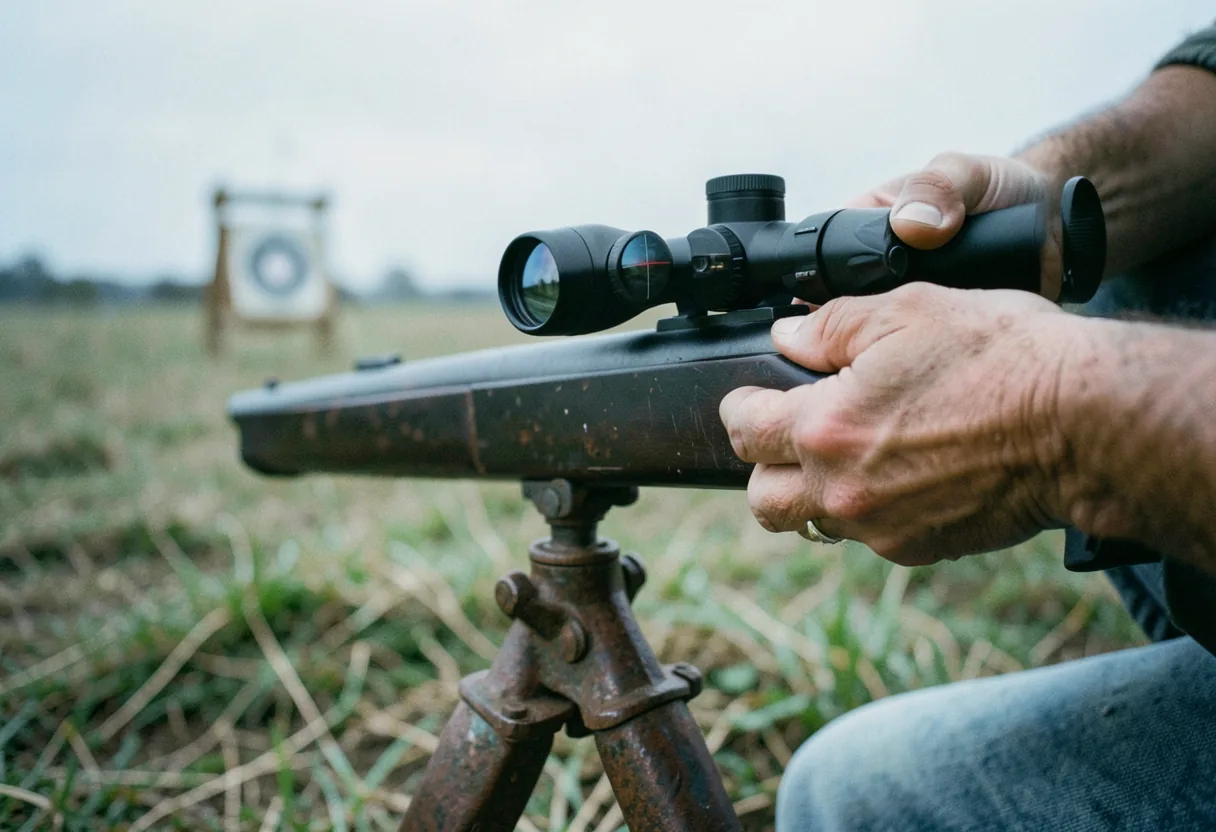
Air rifle long range zeroing is the process of adjusting your sights or scope so that your rifle hits what you’re aiming at, at distances beyond typical indoor ranges. This usually involves shooting at a known distance, observing where your pellets hit, and then adjusting your sights to close the gap between your point of aim and point of impact.
The first time I really looked at zeroing, I was struck by how much it’s like adjusting the aim of a flashlight. You want the beam to hit exactly where you’re pointing, and with zeroing, you’re doing the same thing but with a rifle and pellets. It’s all about precision and patience.
02Why is zeroing important for long range air rifle shooting?
Zeroing is crucial because air rifles have a trajectory arc due to gravity and pellet characteristics. Without zeroing, your shots will be inconsistent, especially at longer ranges. A properly zeroed rifle ensures that you know exactly where your shots will land, allowing you to make informed adjustments for windage and elevation.
For example, if you’re zeroed at 50 yards, you know that your shots will be on target at that distance. At other distances, you can use a trajectory table or holdovers to make adjustments. Without zeroing, these adjustments would be guesswork, leading to missed shots.
03How to zero your air rifle for long range shooting
Here’s a step-by-step guide to zeroing your air rifle for long range shooting:
- Set up your target: Place a target at your desired zeroing distance, typically 25 or 50 yards. Make sure the target is clearly visible and stable.
- Sight alignment: Ensure your sights or scope are properly aligned. This is called sight alignment, and it’s crucial for accurate shooting.
- Fire a shot group: Fire a group of shots (usually 3-5) at the target, aiming for the center. Observe where the shots hit.
- Adjust your sights: If your shots are not hitting the center, adjust your sights to move the point of impact towards the center. Most air rifles have adjustable sights for both windage (left-right) and elevation (up-down).
- Repeat: Fire another group of shots and observe the results. Repeat the adjustment process until your shots are consistently hitting the center of the target.
- Confirm your zero: Once you’re happy with your zero, confirm it by firing a final group of shots. Make sure they’re all hitting the center of the target.
04Adjusting for windage and elevation
Once you’ve zeroed your rifle, you’ll need to adjust for windage and elevation when shooting at different ranges. Windage adjustments compensate for wind pushing your pellets off course, while elevation adjustments compensate for the pellet’s trajectory arc.
For example, if you’re shooting at 75 yards, you might need to aim higher than your zero distance to compensate for the drop. Similarly, if there’s a crosswind, you might need to aim slightly left or right to compensate for wind drift.
To make these adjustments, you can use a trajectory table provided by your rifle or pellet manufacturer, or you can develop your own adjustments through practice. Many shooters use holdovers, where they aim above or to the side of the target to compensate for wind and drop.
05Common mistakes to avoid
Zeroing your air rifle can be tricky, and there are several common mistakes to avoid:
- Inconsistent shooting position: Make sure you’re using the same shooting position for each shot. Inconsistent positions can lead to inconsistent shot groups.
- Ignoring environmental factors: Wind, temperature, and humidity can all affect your shots. Make sure to account for these factors when zeroing your rifle.
- Rushing the process: Zeroing takes time and patience. Rushing through the process can lead to inaccurate results.
- Not confirming your zero: Always confirm your zero by firing a final group of shots. This ensures that your zero is accurate and consistent.
06Tools and accessories for zeroing
Several tools and accessories can make zeroing your air rifle easier and more accurate:
- Target stands: A sturdy target stand ensures your target stays put, even in windy conditions.
- Trajectory tables: These tables provide ballistic data for your rifle and pellets, helping you make informed adjustments.
- Wind indicators: Wind can have a significant impact on your shots. Wind indicators help you gauge wind speed and direction.
- Shooting rests: A shooting rest, like the lead sled, can help you achieve consistent shot placement.
07Practice and refinement
Zeroing your air rifle is not a one-time process. As your shooting skills improve, you may find that your zero needs adjustment. Regular practice and refinement ensure that your zero remains accurate and consistent.
Consider joining a local air rifle club or competing in matches to hone your skills. These activities provide valuable feedback and help you identify areas for improvement. Additionally, experimenting with different pellets and rifle setups can help you find the optimal combination for long range shooting.
08Specific zeroing techniques
Different air rifles and shooting scenarios may require unique zeroing techniques. Here are a few examples:
09Advanced zeroing: Multi-distance zeroing
For long range shooting, some shooters prefer to have multiple zero distances, allowing them to hit targets at various ranges without extensive holdovers. This technique, known as multi-distance zeroing, involves zeroing your rifle at two or more distances, typically 25 and 50 yards.
To achieve a multi-distance zero, you’ll need to adjust your sights so that your shots hit the center of the target at both distances. This requires careful calculation and adjustment, but it can significantly improve your long range shooting accuracy.
10Troubleshooting zeroing issues
Even with careful zeroing, you may encounter issues that affect your shooting accuracy. Here are some common problems and their solutions:
Regular practice, combined with a solid understanding of zeroing principles, will ensure your air rifle is consistently accurate at long ranges. Happy shooting!
11Frequently asked questions
What distance should I zero my air rifle for long-range accuracy?
For most air rifles, 50 yards is the practical maximum effective range. At this distance, you'll need to account for bullet drop. Use a chronograph to measure your rifle's muzzle velocity, then input those numbers into a ballistics calculator for precise adjustments.
How does wind affect air rifle accuracy at long range?
Wind has a significant impact. At 50 yards, a 5 mph crosswind can push a .177 caliber pellet off target by several inches. Use the Kentucky windage method, estimate wind speed and direction, then adjust your aim accordingly. Practice in varying conditions to develop intuition.
What type of scope should I use for long-range air rifle shooting?
A high-quality variable power scope, like the Hawke Sport Optics Vantage IR 4-12×40, is ideal. Look for one with a mil-dot reticle for precise holdovers. Ensure it's calibrated for your rifle's specific caliber to minimize parallax error at long distances.
How often should I re-zero my air rifle for long-range shooting?
Re-zero after any major maintenance, like cleaning the barrel or replacing the spring in a spring-piston rifle. Also, re-zero if you notice a consistent shot group shift. Environmental factors like temperature changes can also necessitate adjustments, so check periodically.