
To zero an air rifle scope, start with a safe backstop at 25 yards. Fire three-shot groups, adjusting the windage and elevation turrets until shots cluster near the center. Confirm at 50 yards.
Zeroing an air rifle scope is the process of adjusting the scope’s turret dials to align the point of aim with the point of impact at a specific distance.
Think of zeroing your scope like adjusting the sights on a toy bow and arrow as a kid, but with math. You’re not just guessing where the arrow will land; you’re making precise tweaks so that when you aim at the bullseye, the arrow hits it every time.
Key facts
- The process typically begins at a distance of 25 to 50 yards, depending on the rifle and scope.
- Both elevation and windage adjustments are made incrementally, with small changes at a time.
- Proper zeroing ensures accuracy and consistency in air rifle shooting.
- Environmental factors like wind and temperature can affect the process.
01What you need
- An air rifle with a mounted scope (e.g., the Crosman Challenger PCP or the Umarex Gauntlet)
- Targets at known distances (25 yards is a common starting point)
- A stable shooting position (consider using a bipod or sandbag rest for stability)
- Screwdriver (for adjusting the scope’s turrets)
- Notebook or app to record adjustments
- Safety gear (eye and ear protection)
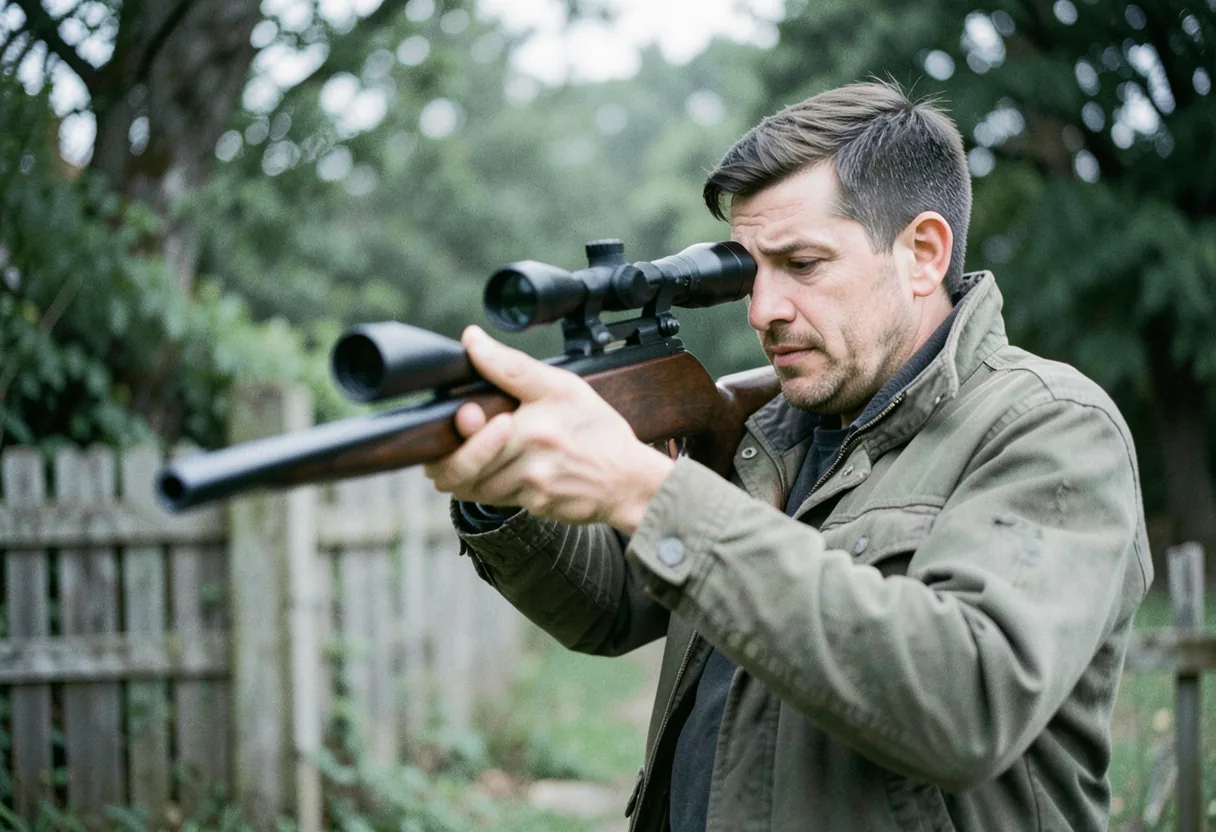
02How to zero an air rifle scope
- Set up your shooting position. Find a safe, flat surface with a clear shooting lane. Use a sandbag or bipod to stabilize your rifle, ensuring a consistent, comfortable stance.
- Aim at your target. Start at 25 yards (or the distance you prefer for your initial zero). Center the crosshairs on the target’s bullseye and fire three to five shots, grouping them together.
- Analyze your grouping. Look at where your shots are landing relative to the bullseye. If they’re clustered to the right, you’ll need to adjust windage; if they’re high, adjust elevation.
- Adjust the scope. Use the turret dials to move the point of impact toward the bullseye. Most scopes have 1 MOA (Minute of Angle) adjustments, so each click moves the impact by about 1 inch at 100 yards. Adjust in small increments, firing another grouping after each adjustment.
- Repeat until zeroed. Continue adjusting and firing until your shots consistently hit the bullseye. This may take several iterations, so patience is key.
- Verify at longer distances. Once zeroed at 25 yards, test your accuracy at 50 yards to ensure consistency. Adjust as needed if your shots are off at this distance.
03Common mistakes to avoid
- Rushing the process. Zeroing takes time and precision. Making large adjustments in one go can overshoot the mark and make the process longer.
- Ignoring environmental factors. Wind, temperature, and even humidity can affect your shots. Always shoot in consistent conditions or account for variations.
- Not stabilizing the rifle. A wobbly shooting position leads to inconsistent groupings. Use a rest or bipod to ensure stability.
- Failing to record adjustments. Keeping track of your adjustments helps you understand how your scope behaves and speeds up future zeroing efforts.
04Understanding MOA vs. Mils
When zeroing your scope, you’ll need to understand the adjustment units. Most air rifle scopes use MOA (Minute of Angle), but some use mils. Here’s a quick comparison:
If you’re using a scope with MOA adjustments, each click typically moves the point of impact by 1/4 MOA, or about 0.25 inches at 100 yards. For mil-based scopes, each click moves the impact by about 0.1 mils, or 3.6 inches at 100 yards. Understanding this helps you make precise adjustments during zeroing.
05How to confirm your zero
Once you’ve adjusted your scope and your shots are hitting the bullseye at your chosen distance, it’s time to confirm your zero. Here’s how:
- Fire a test group. At your zeroing distance, fire three to five shots to ensure they’re still grouping tightly around the bullseye.
- Test at different distances. Move to 50 yards or another distance and fire another group. If your shots are still on target, your zero is confirmed.
- Adjust if necessary. If your shots are off at longer distances, you may need to fine-tune your elevation. Some scopes allow for multiple zeros at different distances.
06Tools and accessories for zeroing
While the basics (rifle, scope, target) are all you need, a few accessories can make the process smoother:
- Target stand. A sturdy stand keeps your targets in place, especially in windy conditions.
- Scope level. Ensures your scope is perfectly level, improving accuracy.
- Ballistic calculator app. Helps account for environmental factors like wind and temperature.
- Shooting mat. Provides a comfortable, stable shooting position.
07Why zeroing matters for air rifle shooting
Zeroing your scope is essential for consistent accuracy, especially in competitive air rifle shooting. A properly zeroed scope ensures that when you aim at a target, your shots will hit where you’re looking. This is particularly important for precision shooting, where every shot counts.
In competitive events, like those hosted by the International Shooting Sport Federation (ISSF), shooters are judged on their ability to hit targets with precision. A poorly zeroed scope can lead to missed shots and lower scores, while a well-zeroed scope gives you the confidence to shoot accurately under pressure.
For recreational shooters, zeroing your scope ensures you’re getting the most out of your air rifle. Whether you’re plinking cans or practicing for a hunting trip, a zeroed scope helps you hit your targets consistently, improving your overall shooting experience.
08How to maintain your zero over time
Once you’ve zeroed your scope, it’s important to maintain that zero. Here are some tips to keep your scope dialed in:
- Handle your rifle carefully. Rough handling can knock your scope out of zero. Always treat your rifle with care, especially when transporting it.
- Check your zero regularly. Even if you’re not shooting competitively, it’s a good idea to check your zero every few months to ensure it hasn’t shifted.
- Store your rifle properly. Keep your rifle in a cool, dry place to prevent damage to the scope. Avoid exposing it to extreme temperatures or humidity.
- Clean your scope. Dust and debris can affect your scope’s performance. Use a soft cloth to clean the lenses and keep the scope free of dirt.
Zeroing an air rifle scope is a critical skill for any air rifle enthusiast. By following these steps and avoiding common mistakes, you can ensure your scope is properly zeroed for consistent, accurate shooting. Whether you’re a competitive shooter or a recreational enthusiast, a well-zeroed scope will help you hit your targets with precision every time.
09Frequently asked questions
Why does my air rifle scope need zeroing?
Zeroing aligns the scope’s crosshairs with the rifle’s point of impact. Without it, you’ll miss targets even at close range. For example, a 10-yard zero means your pellet hits dead center at 10 yards, but you’ll need to adjust for longer distances.
What tools do I need to zero an air rifle scope?
You’ll need a sturdy rest or sandbags to hold the rifle steady, a target at your chosen distance (like 10 or 25 yards), and a small screwdriver to adjust the scope turrets. Some scopes include a bubble level to ensure the rifle is perfectly level.
How often should I zero my air rifle scope?
Zeroing depends on usage. If you shoot frequently, check zeroing every few months. If the scope gets bumped or dropped, zero it immediately. Even minor impacts can throw off alignment. Consistency is key for accuracy.
Can I zero an air rifle scope indoors?
Indoors, use a laser boresighter to align the scope with the barrel. This provides a rough zero, but you’ll still need to fine-tune at a range. The laser ensures the crosshairs are close to the barrel’s centerline, saving time outdoors.