
Air rifle long range shooting favors prone or kneeling positions. Prone offers the best stability, with your body fully supported. Kneeling provides good balance and is easier to adjust. Use a sandbag or bipod for extra support. Aim for a consistent cheek weld and natural point of aim to minimize muscle strain at 50 meters or beyond.
01Understanding air rifle long range ballistics
Air rifle long range shooting positions are the techniques used to stabilize and support your rifle to maximize accuracy and consistency at distances beyond 50 meters.
Think of it like balancing a long stick on your palm. Just as you adjust your hand and arm to keep the stick upright, you adjust your body and gear to steady your rifle for that perfect shot.
Key facts
- There are four main shooting positions: prone, sitting, kneeling, and standing, each with variations for long range.
- Proper body alignment and muscle relaxation are critical for minimizing shot deviation.
- Support equipment like bipods, slings, and rear bags can significantly improve stability.
- Long range positions often require adjustments for windage and elevation, which are unique to each shooter’s setup.
02Why air rifle long range shooting positions matter
The first time I really looked at the difference between standard and long-range positions, I noticed how much more precise the latter had to be. At distances over 50 meters, even minor shifts in your body or gear can cause significant shot deviations. Long-range positions help you maintain a consistent point of aim and minimize these deviations.
For example, in prone position, your body forms a stable platform. But for long range, you’ll often use a bipod and adjust your elbow position to fine-tune stability. Similarly, in standing position, a shooting sling can help support the rifle’s weight and reduce fatigue, allowing for better control over extended shooting sessions.
03Prone position for air rifle long range shooting
The prone position is the most stable for long range shooting. You lie on your stomach, using a bipod or sandbag to support the rifle. Your head should be positioned so that your dominant eye is directly behind the sight, with your cheek firmly against the stock.
To maximize stability, relax your body and distribute your weight evenly. Tension in your muscles can transmit to the rifle, causing inaccuracies. Practice adjusting your elbow position to find the sweet spot where the rifle is most stable.
Remember, the goal is to create a rigid triangle of support between your bipod or sandbag, your elbow, and your body. This triangle helps absorb recoil and minimizes movement during the shot.
04Sitting and kneeling positions for air rifle long range shooting
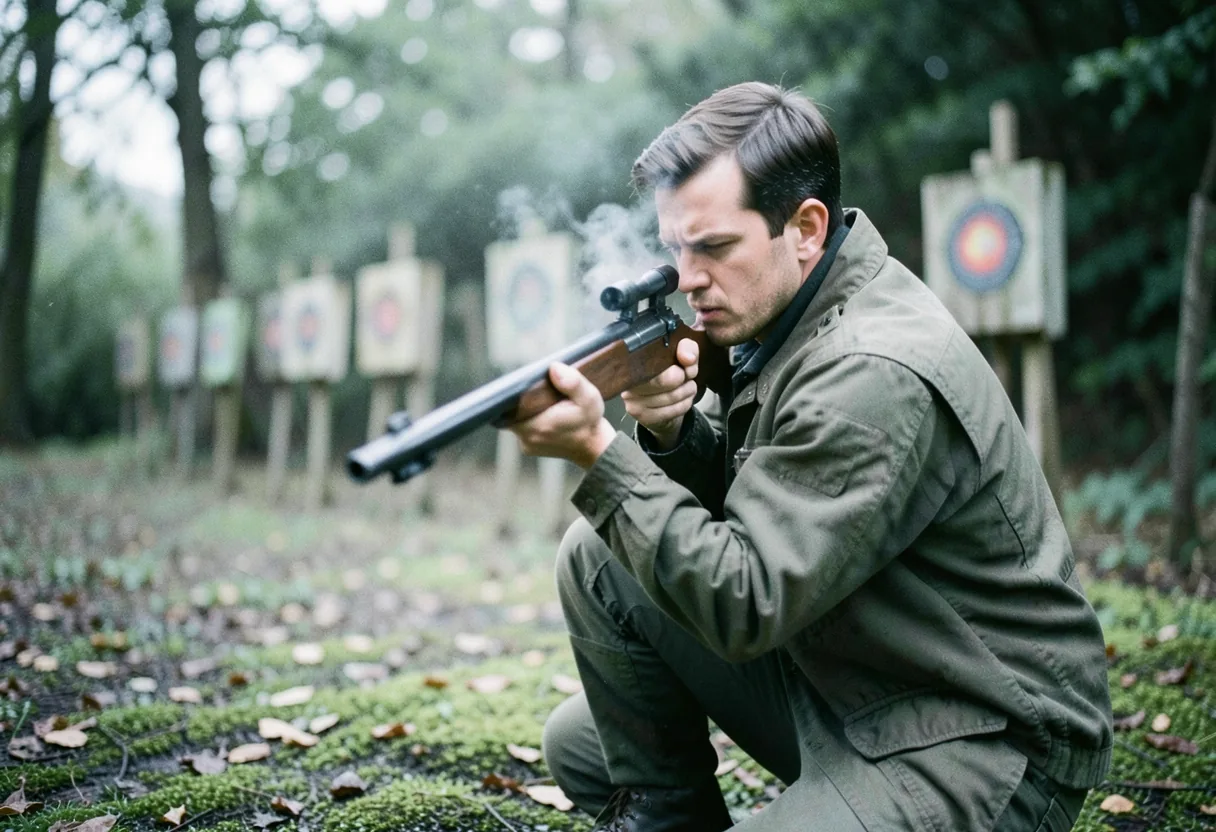
When the terrain doesn’t allow for prone shooting, sitting and kneeling positions are excellent alternatives. In the sitting position, you sit with your legs bent or crossed, using a sandbag or your knee to support the rifle. The kneeling position, also known as the “free kneeling” position, involves kneeling on one or both knees, using a sandbag or your knee for support.
For long range shooting, these positions require more upper body strength and stability. Using a shooting sling can help distribute the rifle’s weight and reduce fatigue. Additionally, practice adjusting your support hand position to fine-tune stability and control.
05Standing position for air rifle long range shooting
The standing position is the most challenging for long range shooting, as it offers the least stability. However, it’s also the most versatile, allowing you to shoot from various positions and adapt to changing environments. To maximize stability, use a shooting sling to support the rifle’s weight and reduce fatigue.
Position your dominant foot forward, with your knees slightly bent to absorb recoil. Keep your upper body upright and relaxed, with your non-dominant hand supporting the rifle’s forearm. Practice adjusting your stance and hand positions to find the most stable configuration for your body and rifle.
06Support equipment for air rifle long range shooting positions
Support equipment can significantly improve your stability and accuracy in long range shooting. Bipods, sandbags, and shooting slings are all excellent options, depending on your shooting position and personal preferences.
For prone shooting, a bipod or sandbag can provide excellent forward support. In sitting and kneeling positions, a sandbag or your knee can serve as a stable forward rest. Shooting slings are versatile and can be used in all positions to support the rifle’s weight and reduce fatigue.
When choosing support equipment, consider factors like weight, portability, and adjustability. The best equipment is the one that fits your shooting style and helps you achieve consistent, accurate shots.
07Adjusting for windage and elevation in air rifle long range shooting positions
At long range, windage and elevation adjustments become crucial for accurate shooting. Wind can significantly affect your shot, especially at distances over 50 meters. Practice reading the wind and adjusting your sight accordingly. Remember that wind calls can vary based on your rifle’s power, pellet weight, and environmental conditions.
Elevation adjustments are also critical for long range shooting. Most air rifles require elevation adjustments for shots beyond 50 meters. Practice dialing in your elevation and confirming your zero at various distances. Consider using a target with multiple aiming points at different distances to streamline this process.
08Understanding air rifle long range ballistics
Ballistics is the study of the motion of projectiles, and understanding it is crucial for long range air rifle shooting. The trajectory of a pellet is influenced by several factors, including initial velocity, air density, and gravitational pull. At long ranges, even small changes in these factors can significantly impact accuracy.
The pellet’s trajectory can be divided into three phases: internal ballistics (what happens inside the rifle), external ballistics (the pellet’s flight through the air), and terminal ballistics (the pellet’s impact with the target). For long range shooting, external ballistics are particularly important, as they determine how the pellet behaves in flight.
One of the key concepts in external ballistics is the pellet’s ballistic coefficient, which measures its ability to overcome air resistance. A higher ballistic coefficient indicates a more aerodynamic pellet that experiences less drag, resulting in a flatter trajectory and less wind drift. When choosing pellets for long range shooting, consider their ballistic coefficients to maximize accuracy.
Additionally, understanding the effects of wind on your shot is crucial for long range shooting. Wind can push your pellet off course, especially at longer distances. Crosswinds, headwinds, and tailwinds all affect the pellet’s trajectory differently, so it’s essential to practice reading the wind and adjusting your aim accordingly. Tools like wind meters and ballistic calculators can help you make more precise adjustments.
09Advanced techniques for air rifle long range shooting
Once you’ve mastered the basic shooting positions and understand the fundamentals of ballistics, you can start exploring advanced techniques to further improve your long range shooting skills. One such technique is known as “doping the wind,” which involves making precise adjustments to your aim based on detailed wind observations. This technique requires a deep understanding of how wind affects your pellet’s trajectory and practice in reading subtle wind cues.
Another advanced technique is the use of “holdovers” and “holdunders.” These involve aiming at a point above or below your target to compensate for bullet drop or wind drift without adjusting your sights. For example, if you’re shooting at a target 100 meters away and you know your pellet will drop 5 cm, you might aim at a point 5 cm above your target. This technique requires a deep understanding of your rifle’s ballistics and consistent practice to develop muscle memory.
The covers these advanced techniques in detail, providing hands-on training and expert guidance. Additionally, the is a valuable tool for calculating precise holdovers and wind adjustments based on your specific rifle and pellet combination.
Mastering air rifle long range shooting positions takes practice and patience. Start by familiarizing yourself with each position and its unique challenges. Then, practice adjusting your body and gear to maximize stability and control. Remember, the key to long range accuracy is consistency, so focus on developing a repeatable process for each shot.
Consider enrolling in a long range shooting course, such as those offered by the National Rifle Association (NRA), to gain expert insights and hands-on experience. Additionally, practice reading the wind and adjusting for elevation using resources like the National Weather Service (NWS) for accurate wind data.
For more information on air rifle long range shooting, check out our articles on pellets, diopter sights, zeroing, and barrel tuning. Also, visit the International Shooting Sport Federation website for regulations and resources on competitive air rifle shooting.
To improve your long range shooting skills, follow these steps:
- Practice each shooting position regularly to build muscle memory and consistency.
- Experiment with different support equipment to find what works best for you.
- Develop a repeatable process for each shot, including body positioning, breathing, and trigger control.
- Practice reading the wind and adjusting for elevation at various distances.
- Seek feedback from experienced shooters or coaches to identify areas for improvement.
- Participate in long range shooting competitions to gain experience and test your skills.
Remember, the key to success in air rifle long range shooting is consistency. By mastering the fundamentals and practicing regularly, you’ll develop the skills and confidence needed to hit your targets at any distance.
10Frequently asked questions
What's the maximum effective range for air rifle long-range shooting?
The effective range varies by rifle and skill, but most PCP air rifles can consistently hit targets at 50-75 yards. The Air Arms TX200 Mk3, for example, can reach out to 100 yards with experienced shooters using .22 caliber pellets. Beyond that, accuracy drops significantly due to pellet drop and wind drift.
Why is the prone position preferred for long-range air rifle shooting?
The prone position offers the most stability, reducing human error. By lying flat on the ground, shooters minimize muscle fatigue and maximize support for the rifle. The rifle's bipod or sandbag can be used to steady the shot, crucial for maintaining precision at extended ranges where even slight movements affect accuracy.
How does wind affect long-range air rifle shooting?
Wind is a major factor because pellets are lightweight and easily pushed off course. A 5 mph crosswind at 50 yards can displace a .177 caliber pellet by several inches. Shooters adjust for wind by estimating its speed and direction, then compensating by aiming into or away from the wind, depending on the angle.
What’s the best way to practice long-range air rifle shooting?
Start with short distances and gradually increase as accuracy improves. Use targets with clear, high-contrast markings to track hits. Regularly clean and maintain your rifle to ensure consistent performance. Joining a local air rifle club can provide access to experienced shooters and specialized facilities, like 100-yard ranges.