
Air rifle bench rest shooting involves stabilizing your rifle on a bench or rest to improve accuracy. Use a front and rear bag rest or a sandbag for support. Maintain a consistent cheek weld and trigger control. Practice at 10, 25, or 50 yards, depending on your skill level and competition rules.
Air rifle bench rest shooting is a precision discipline where shooters use a bench to stabilize their air rifle, eliminating body movements to achieve maximum accuracy.
think of it like a sniper’s meditation: you’re not just shooting, you’re becoming a human tripod, blending rifle, bench, and your own steady breathing into a single, motionless point aimed at perfection.
Key facts
- The bench rest position reduces shooter-induced movement to sub-0.1 MOA (Minute of Angle) levels.
- Competitions often require shooting at 10m, 25m, or 50m distances, with tight grouping scores determining winners.
- Bench rests can be either front bags or full bench mounts, each affecting stability differently.
- Top-tier air rifle bench rest shooters, like those in the International Shooting Sport Federation (ISSF), often achieve sub-5mm groupings at 10m.
01Front Bag vs. Full Bench Mount: Stability Showdown
When it comes to air rifle bench rest shooting, your choice of support can mean the difference between a tight 5-shot group and a scattered mess. The two main options are front bags and full bench mounts, each with distinct advantages and trade-offs.
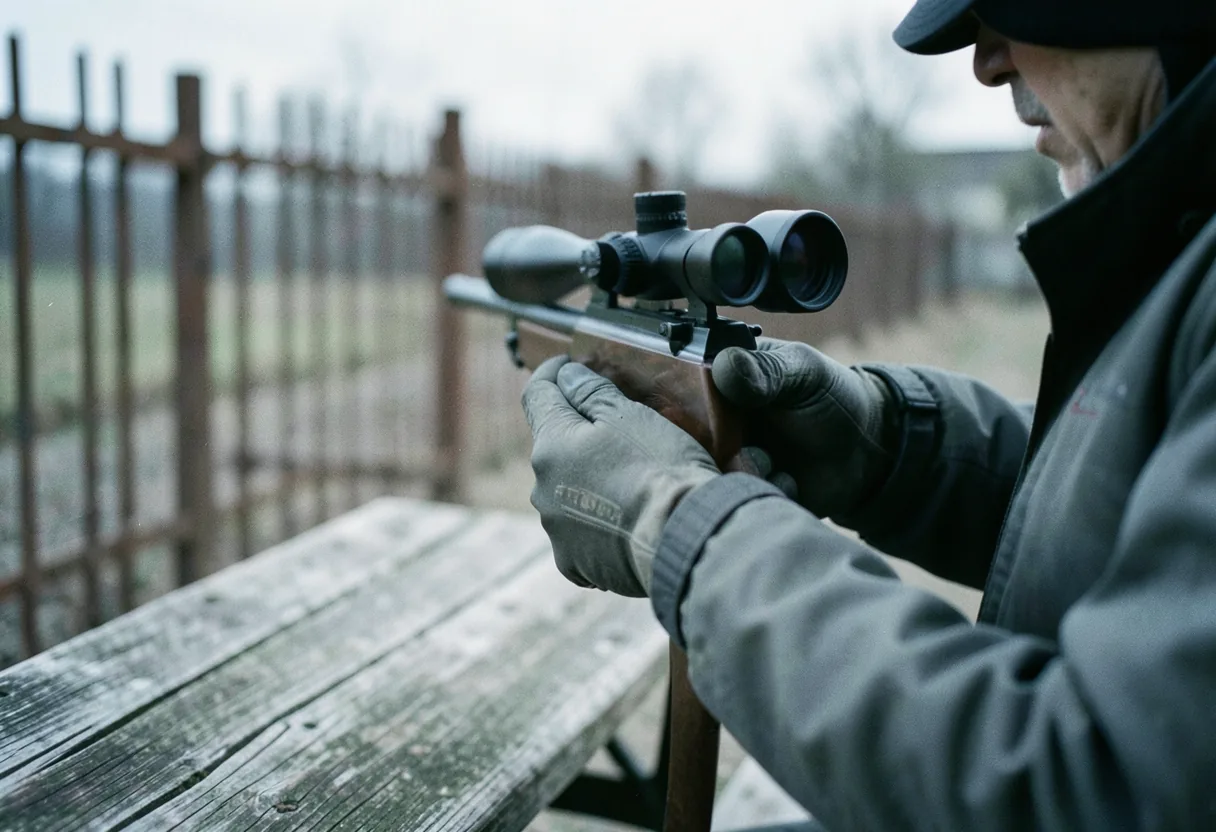
02Front Bag: Minimalist Precision
A front bag is the lightweight, portable option for air rifle bench rest shooting. It’s essentially a padded bag filled with sand or lead shot, designed to cradle the rifle’s fore-end while allowing fine adjustments with your off-hand.
The first time I really looked at a front bag setup, I was struck by how much it relied on the shooter’s posture. Unlike a full bench mount, which locks the rifle in place, a front bag lets you make subtle corrections mid-shot, helpful for dialing in windage or elevation on the fly. However, this flexibility comes at a cost: any wobble in your elbow or shoulder translates directly into the shot. For casual shooters or those who prioritize mobility, a front bag is a solid choice.
The main drawback? Consistency. Even the slightest change in how you rest the rifle can throw off your grouping. If you’re not meticulous about your form, you’ll see those groupings widen faster than you’d like.
03Full Bench Mount: The Sniper’s Anchorage
A full bench mount is the heavy-duty solution for air rifle bench rest shooting. It clamps your rifle to a solid base, eliminating nearly all shooter-induced movement. Think of it as strapping your rifle to a concrete slab, once it’s locked in, it’s not going anywhere.
This level of stability is why competitive shooters, especially those in ISSF-sanctioned matches, swear by full bench mounts. The alignment is critical: even a 0.5mm misalignment at the mount can throw off your shot at 50m. But once dialed in, the results are breathtaking. Sub-3mm groupings at 25m? That’s not uncommon with a properly tuned setup. The downside? Cost and bulk. A quality bench mount like the Caldwell BR Front Rest will set you back a few hundred dollars, and it’s not something you’ll want to haul to the range unless you’re driving a truck.
04How to Choose
- Budget: If you’re working with $50 or less, a front bag is your only realistic option. For $250+, a full bench mount becomes viable.
- Portability: Need to shoot at multiple ranges or in the field? A front bag is far easier to transport.
- Skill Level: Beginners often benefit from the flexibility of a front bag to learn adjustments. Advanced shooters will appreciate the rigidity of a full bench mount.
- Competition Rules: Some matches restrict or favor specific setups. Check the rules before investing.
05Air Rifle Bench Rest Shooting: The Bottom Line
If you’re serious about air rifle bench rest shooting, your setup matters. A front bag is great for practice and portability, but a full bench mount is the gold standard for competition. The trade-off? Cost, bulk, and setup time. But when you’re staring down a 50m target and your shot groups are tighter than your last competition’s winning margin, you’ll know it was worth it.
The next step? Get familiar with accuracy tuning, because even the best bench rest setup won’t save you from a poorly tuned rifle. Happy shooting.
06Frequently asked questions
What's the minimum distance for air rifle bench rest shooting?
The minimum distance is typically 10 meters for most competitions, but some matches use 25 or 50 meters to increase difficulty. The choice depends on the specific rules of the event.
How do you stabilize an air rifle in bench rest shooting?
Use a solid front rest and a rear bag to support the rifle. The front rest cradles the barrel, while the rear bag stabilizes the buttstock. Proper positioning ensures minimal movement when firing.
What's the best caliber for bench rest shooting?
The .177 caliber is popular for its flat trajectory and low wind sensitivity, but .22 caliber offers more power and stability. The choice depends on the target distance and shooter preference.
How often should you clean your air rifle barrel?
Clean after every 300-500 shots or when accuracy drops. Use a cleaning rod, brush, and patches soaked in gun oil. Regular maintenance prevents fouling and maintains precision.